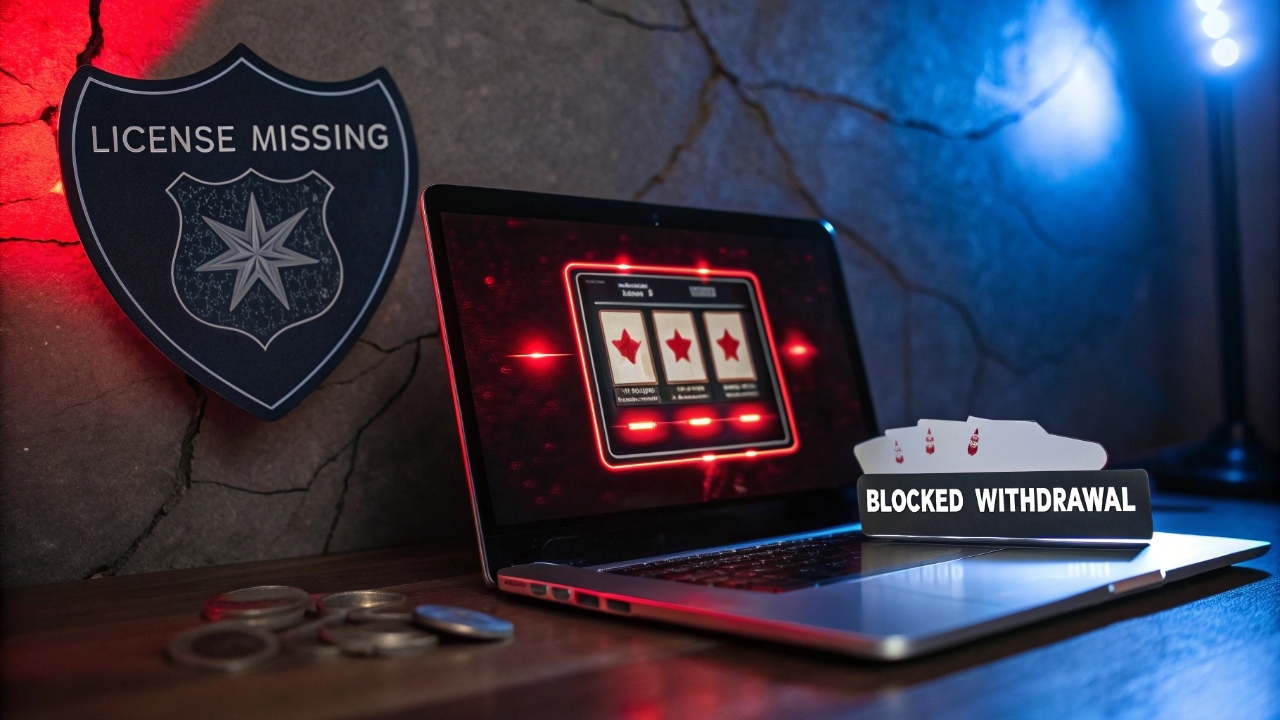
Interest in online casinos is growing, and with it, the number of platforms operating without official regulation is increasing. At first glance, such sites may look attractive: bright bonuses, fast registration, and minimal checks. However, behind this simplicity there is often a lack of basic guarantees for users. When an operator has no license, the player is effectively left alone with rules that can change at any moment and are almost always interpreted in favor of the platform.
The main problem with unlicensed casinos is not limited to a possible loss of deposit. It involves a much broader set of threats: from account blocking after a win to the use of personal data in questionable schemes. In a regulated environment, a player can contact a supervisory authority or licensing jurisdiction, while in the gray market, protection mechanisms are either absent or purely formal. That is why licensing is not a formality or a tiny “checkbox in the footer,” but a core safety criterion.
Why the Absence of a License Changes the Rules of the Game
A license is a legal framework that requires a casino to follow standards of transparency, financial accountability, and customer protection. Without this framework, an operator does not bear comparable responsibility to the player. In practice, this means bonus terms, withdrawal limits, and verification requirements can be used as pressure tools, especially when a user tries to cash out a large amount. Today the rules may look friendly, and tomorrow a new clause appears that makes withdrawal nearly impossible.
Another major risk concerns the fairness of gaming software. In licensed projects, random number generators and game algorithms are usually subject to independent audits. In unlicensed casinos, such checks are either not conducted or not documented in a verifiable way. For the player, this creates fundamental uncertainty: there is no reliable way to confirm that game outcomes are generated fairly rather than manipulated in the operator’s favor. Even with occasional wins, there remains a high chance that at the withdrawal stage delays begin, extra documents are requested, or the profile is blocked unilaterally.
Financial and Legal Consequences for the Player
When a user deposits money on an unlicensed platform, they often underestimate how difficult it is to recover funds in a dispute. A bank or payment provider cannot always help effectively, especially if transactions went through chains of intermediaries, crypto channels, or foreign gateways with opaque jurisdiction. As a result, even an obvious payout dispute turns into a long and largely hopeless process. The player loses not only money, but also time and control over the situation.
The legal aspect is no less important. In some countries, participating in games on illegal platforms can create additional risks for users, including restrictions on financial operations and complications when proving the source of funds. Even if claims are not raised directly against the player, interaction with a questionable operator increases the likelihood of problems with payment identification and personal data security. If a data leak occurs, the consequences can go far beyond a gaming account: from spam and phishing to attempted access to other services where similar passwords or contact details were used.
How to Minimize Risks and Keep Control
A conscious approach starts with checking the legal status of a platform before registration and deposit. It is important not only to see a license number on the website, but to verify that it exists in the regulator’s registry and belongs to that specific brand. A reliable operator usually publishes transparent rules, clear payout timelines, and a data policy without ambiguous wording. If key terms are hidden behind vague phrases, this is a high-risk signal, even when bonuses and advertising look attractive.
Financial safety also depends on the player’s own discipline. It is wise to use separate payment methods for online entertainment, avoid storing large sums in a gaming balance, and stay away from platforms that push non-transparent deposit channels. Digital hygiene matters too: unique passwords, two-factor authentication, and permission control reduce the chance of related losses. The main takeaway is simple: unlicensed casinos almost always shift risks onto the player. The sooner this is understood, the higher the chance of protecting money, data, and peace of mind.